Thursday, June 5, 2014

Coming of Age: ‘Hollywood' in Singapore: Pt. 2


The Virgin Soldiers, John Dexter, shot: 1967/released: 1969


“It rained a lot, and steamed when the sun shone. It was always hot. But it was safe.” 

A few weeks ago Leslie Thomas died. He was a relatively prolific novelist producing a book a year for a long time, but, as the obits made clear, best known as the author of The Virgin Soldiers, a fictionalised account of his years as a conscripted private stationed in Malaya, and more specifically, Singapore between 1949 and ’51. This was the early phase of the ‘Malayan Emergency’ when British forces fought viciously with anti-colonial, pro-communist guerilla squads who’d shifted from being a local resistance against the invading Japanese (trained and armed by the Allies) to terrorists determined to ‘free’ Malaya from the British. It's a conflict little represented in fiction before or since. The literary precursors to Thomas’s book were Anthony Burgess’s Malayan Trilogy in the late 50s, and Michael Keon’s The Durian Tree in ‘59, filmed in 1964 as The Seventh Dawn, a forgotten attempt to render the Emergency as a big-budget war epic. None of these would have the popular impact of The Virgin Soldiers.

Published in 1966, a good fifteen years later after these formative events for Thomas (but only six years after the Emergency was declared over) the book was a massive bestseller in its time, both in the UK and America. An irreverent, iconoclastic look at military life in the aftermath of World War Two, The Virgin Soldiers ("the best three words I ever wrote" Thomas later said) was firmly anti-war, anti-authoritarian and, most importantly, pro-sex, chiming perfectly with the period. Sales were aided by a series of lurid book covers (the first edition projects an image of a soldier in a jungle, Maurice Binder-style, onto a naked female torso) and its reputation for being “intensely erotic”, as Publisher’s Weekly helpfully blurbed for the paperback.


The story’s recounted mostly from the point-of-view of Thomas’s alter-ego, Brigg (ironically General Briggs was responsible for British strategy during the Emergency), a vaguely working class chap in his early 20s whose National Service stint brings him to Panglin Camp (a jokily renamed Tanglin Barracks, although Thomas was actually stationed at Nee Soon Camp) to be a pay clerk, doing admin in the arse-end of beyond (miles from the action), where the most useless, stupid and unfit for duty are deliberately “mislaid by the army".

It’s about the tedium of the posting - the practical jokes, the petty squabbles, being horny and bored and powerless in a foreign country. But riots break out in Singapore and even the pen-pushers get into the fray. At first Brigg’s only interested in losing his virginity; sights are set on Philippa, the daughter of the Sergeant Major, but he settles for ‘Juicy’ Lucy, a pretty Chinese dancer at the Liberty Club downtown, who’s never had a virgin before and loves it (coining the titular phrase). Meanwhile Philippa, resentful of her Singapore life, whose father openly worries she’s a lesbian, is deflowered by Driscoll, the tough-bastard Sergeant haunted by a wartime incident in which he accidentally shot his own lads, and whose hatred of the other Sergeant Wellbeloved, a cruel, incompetent racist constantly boasting of military heroics, becomes a crucial narrative thread.

Thomas sketches miniatures of Brigg’s mates - the train-obsessive Sinclair, openly gay Villiers and Foster, bespectacled Brook, overweight Fred Organ, and scheming Fenwick (who's convinced he’ll be discharged if he keeps his ears under water until he’s deaf) through a series of episodes big and small. There’s the interminable camp dance, a brutal dog-shooting competition, the anti-British riot (which sees Brigg try to play hero by ‘rescuing’ Philippa and her dotty mother), a long messy fight between Driscoll and Wellbeloved, R&R in Georgetown (where Brigg and Philippa finally have sex) building up to the novel’s climax – Brigg and the boys seeing real action when their train back to Singapore (through the Malayan jungle) is ambushed by bandits. 

Thomas takes it leisurely, keeps the banter among the men earthy and often genuinely funny, and ensures the spectre of terrible violence is always close. An early chapter begins with the sentence: “When the Japanese had been in Panglin during the war they had taken some Australians down to the cricket field and murdered them.” He does this again and again, shifting from an amusing or relatively innocuous detail into something to do with death, as casually as you might mention a change in the weather.

Singapore is minimally described, like a scrawled map for a weekend visitor. There’s the “village” near the camp, the centre of town where the boys visit the Liberty Club “just off the Padang”. Lucy’s flat’s on “Sarangoon Road (sic)”. When the riot breaks out they roam the city, passing the Cathay cinema (showing Elia Kazan’s Panic in the Streets) and Raffles Hotel (for “people with money”) and setting up temporary camp in the “Golden World amusement park”. The only Singaporean character (let’s skip “Fuk Yew” the laundryman whose fingers Brigg accidentally shoots off) is Lucy. Sexually generous and deeply whimsical, she’s a stereotype but so fondly drawn that when Brigg finds out she’s been murdered by a gang of British soldiers who thought she’d passed them VD, it’s devastating. Even more so as Brigg pushes his grief away and wonders “if she did have the disease” (she didn’t). When the book was published, Walter Warwick, reviewer for The Straits Times (an expat with his own post-war memories), found it sensationalised, “The Pay Corps was never like this,” he sniffed.


In the late '60s, Ned Sherrin, on a hot-streak after producing That Was The Week That Was, was offered a job as an executive for Columbia Pictures in London. With theatre and TV contacts up the wazoo, Sherrin was a classy hire. The Vietnam War was still raging in Indochina, and the ‘youth picture’ with counter-cultural overtones was emerging as a commercial genre (Columbia were the studio that picked up – and made a fortune from - Easy Rider in ’69), so the story of young guys making love not war, seemed opportunistically right for the studio. Sherrin, by his own admission not a rock n’ roll guy, simply wanted to make a good film capturing the book’s spirit. 

Credits for writing the thing are complicated. The top credit, "screenplay", goes to John Hopkins (the bigger font size in the opening credits says it all), but "adaptation" is credited to John McGrath and “additional dialogue” is by Ian La Frenais. Hopkins and McGrath both started off in television, primarily on police procedural Z Cars, episodes of which Hopkins wrote and McGrath directed. McGrath would become a legendary political theatre-maker in the 70s, but in the late ‘60s he was a jobbing screenwriter, adapting his own anti-war play, The Bofors Gun (1968) as well as Len Deighton’s Billion Dollar Brain (1967) for Ken Russell (the Edinburgh International Film Festival just annouced a tribute to his screenwriting this year; The Virgin Soldiers is absent). Hopkins was a prolific writer of lauded ‘Wednesday Plays’ and other one-off TV dramas, and had done a major rewrite on the troubled script for Thunderball (1965). McGrath probably did the first draft (hence the adaptation credit), which was, for whatever reason, substantially rewritten by Hopkins, and sitcom king La Frenais, a specialist in dry funny dialogue, came in for the polish.

The script retained the novel’s major set-pieces, leaning towards Brigg’s point-of-view, including a first-person voice-over narration glueing the various episodes together. As in any adaptation there are big changes and contractions. Rather than have Brigg and Philippa reunite in Georgetown, the film consumates their lust much earlier beside the pipeline during Brigg’s comical rescue, and once that’s done Philippa’s barely seen again. The most fundamental ommission is Lucy’s death, which I presume was just too disturbing to include. The culminative effect of these tweaks is that once Brigg and Philippa lose their respective virginities (rapidly crosscut together in that stylised late '60s style) both the romantic and sensual aspects of the book slacken off. A neater move is to make Wellbeloved's cowardice something that actually happens on-screen, placing him on the ambushed train (hiding in the toilet) in the film’s climax, rather than have Driscoll confront him about something that he reportedly did in the war.

John Dexter, a theatre-director associated with the great post-war theatre generation led by Laurence Olivier, was picked by Sherrin to make his cinema directing debut with The Virgin Soldiers. Hywel Bennett, a Welsh-born, London-raised and RADA trained young actor (with just a few TV credits at that point) got the plum part of Brigg, and established British star Nigel Davenport played Driscoll (around same time he recorded all of HAL’s dialogue for Kubrick’s 2001: A Space Oddysey, and was Michael Caine’s reluctant wartime partner in Andre De Toth’s excellent, underseen Play Dirty), a rather too-young Jack Shepherd was Wellbeloved, and Lynn Redgrave (who’d just played Noel Coward’s Pretty Polly in the TV version of the Singapore-set story) was cast as Philippa, alongside her real-life mother Rachel Kempson (wife of Michael Redgrave), playing her mum. 


That particular bit of casting was of vital importance to Singaporeans, according to The Straits Times, who, when they found out, devoted several articles to the “Royal members of British filmdom” deigning to visit the former colony. When filming had been announced earlier in 1967, Cathay’s managing director Tom Hodge, a tireless cheerleader for foreign productions in Singapore, was convinced the decision was due to the “tremendous success” of the Pretty Polly shoot the year before, “when the fullest possible co-operation was given by the Singapore authorities.” Location filming started with a week and a half in Port Dixon, Malaysia for the beach R&R scene and some jungle exteriors, followed by five weeks in Singapore, where they needed an army camp or barracks to stand in for Panglin.

Built in the late 1930s, Selerang Barracks was part of the British forces coastal defences, but when Singapore fell to the Japanese in 1942, it became a prison, containing the overspill of captured British and Australian soldiers from Changi. It would be the site of a notorious stand-off between Commander General Shimpei Fukuye and every military POW in Singapore when the Japanese General demanded prisoners sign a statement promising to cease all escape attempts, after four had been caught fleeing from Changi. When the officers refused, Fukuye had every single prisoner marched into Selerang, squeezing an estimated 15000 men into a space designed for 800, most of them forced to live pressed together in the parade square with only a tiny amount of water and few toilets. At the same time the four escapees were executed on Changi Beach. After several days when it was clear that more would die in these conditions the officers capitulated. The POWs signed the document, many using nonsense or fictional names, Ned Kelly was a popular one with the Australians. This barracks, still under the command of the British Army two years after independence, was granted to The Virgin Soldiers' shoot, with its resident servicemen as extras.

In the lead-up to the arrival of crew, Tom Hodge let slip that “a local girl” might be needed to play Lucy, although that offer was soon downgraded to being a “stand-in” for the Chinese London-based actress Tsai Chin (Fu Manchu’s daughter in several Harry Alan Towers flicks), whose scenes would be shot in London on a set. After auditions they picked Ng Lee Ngo, a student who “seemed to be harbouring an anxiety” according to The Straits Times reporter on the beat. She was replaced by Denise Chew, an ex-Bunny Girl at the Playboy Club in London, glimpsed in the completed film very briefly (in two fleeting shots which keep her face hidden) chucking Brigg’s trousers into an alleyway. Two years later, the reviewer for The Straits Times would describe her performance as “brilliant”.
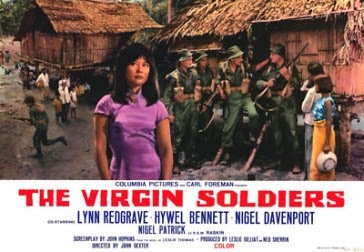


Filming in Singapore lasted five weeks, with the Redgraves flying in for the last nine days, before everyone shipped out on the 5th of October 1968, to begin a month of shooting on sets built in Shepperton. Almost all the interiors were built and shot there, including the barracks bar for the garrison dance scene, which features an impossibly brief appearance by a pre-stardom David Bowie, being shoved out from behind the bar. Bowie, who would later come to Singapore for real and make a film about it, cut his hair for the part (a big gesture in 1967), and was rewarded with about one second of screen time.

Before filming had started, Sherrin asked Ray Davies, lead singer and songwriter for The Kinks, to write music for the film (and offered him a part - he wisely declined). Davies came up with a new composition, The Virgin Soldiers March for a full orchestra and brass band, and penned some unironic “noble” lyrics to accompany the theme. These were rejected by Columbia who hired two lyricists Eddie Snyder (who co-wrote Strangers in the Night) and Larry Kusik to write lyrics that they believed (according to Sherrin) were “going to lead the whole of young America marching on Washington”. Sherrin declared them “apalling”, and nixed them too (and rightly so, as proven by a tepid vocal version, The Ballard of the Virgin Soldiers recorded by folk singer Leon Bibb in 1970). 

Davies’s music (credited to “Raymond Douglas Davies” ensuring it would be lost to only the most die-hard of Kinks fans), manages to be both plaintive and gloriously celebratory. It plays over the opening credit sequence, a relentless monochrome image/photo-montage of young soldiers, from the Napoleonic War through to World Wars One and Two, before we’re dropped into an initially baffling series of shots of uniformed boys in vivid color - the titular “Virgins” - waiting for the national anthem to be over so they get on with a night of drunken debauchery in The Liberty Club. Then we transition into the first pages of the book, with Brigg on early morning tea duty walking through Selerang/Panglin at first light, palm trees looming in the grey-blue sky as Hywel Bennett’s deathly hush of a voice-over sets the scene.

The film starts strong. It’s beautifully shot (by Ken Higgins a TV cameraman whose other notable credit was Georgy Girl), and has the good habit of dropping us into scenes that have already begun. Coming from theatre, John Dexter’s adept at choreographing sizeable groups of actors in the foreground of medium shots (often with some bit of business happening in the background), before cutting to close-ups of one of his young actors, yelling or looking utterly bewildered. It’s crisp and brisk and entertaining, until the episodic trudge of the narrative begins to weigh the film down around the halfway mark, as does the broad, theatrical delivery of the dialogue by most of the young soldier cast, who aside from Bennett (who we’ll get to in a bit) are nothing to write home about (save for Christopher Timothy and an improbable Wayne Sleep, the rest of the lads are destined for lifetimes in soaps and daytime TV).

Cinematic fireworks are saved for the train ambush at the end, which begins with a beautiful tracking shot from the outside, looking into carriage windows at night (prefiguring Wes Anderson’s The Darjeeling Limited), and then when the battle begins, deploying more tracking shots to capture the explosions and violent chaos. This entire set-piece was shot in the UK, with mocked-up train interiors in the studio and the exteriors, complete with a crashed Fifteen Guinea Special steam train (one of the last in existence), shot with rural Essex (on some miraculously sunny days for October) standing in for the Malayan jungle. Dexter would never make another film on this scale, he followed The Virgin Soldiers with two peculiar independents, Pigeons (1970) and I Want What I Want (1972), and then returned to theatre and opera.

The aforementioned tone of the book, the way Thomas slides wry details of camp life alongside devastating revelations, proves unadaptable, although Dexter and co give it the good British try. Thomas could write a line like “Fred Organ, heavyweight kicker of anti-personnel mines, wasn’t listening.” but when you show a fat, loveable slob having his body blown-up during a football match, you have to do just that. Thomas's casual shocks (little literary landmines) become big drama on screen. Some things are toned down, as already mentioned, Lucy survives, and the scene where Wellbeloved confronts a naked “Malay girl” alone in her house during a kampong search is, in the book, clearly an attempted rape, foiled by Brigg and company, whereas in the film it’s sinister but not a precursor to violence (Wellbeloved was looking for “a bit of bare tit”, as Driscoll observes, clarifying that he’s a disgusting creep, but not a rapist). 

The idea of the ‘anti-hero’ was a topical one in the late '60s, as conflict and rebellion around the world led to a sustained questioning of what exactly a hero was in so much culture of the era. The film never allows us to consider Brigg as a hero for a second, even when he appears to be rescuing Philippa and her mother, he’s clumsy and terrified (just as in the book), and his primary motivation is erotic rather than heroic. During the train ambush the film actually takes Brigg’s anti-heroism further. Trapped in a foxhole with the far more experienced (in the book, traumatised) “jungle soldier” Waller (played by future Commander of the Night’s Watch, James Cosmo), he accidentally causes Waller’s death by calling for him at the wrong moment, which leads into his cowardly departure from combat, saving himself from death by running away and then inadvertently avoiding court-martial by finding a train full of soldiers to come to the rescue. 

Hywel Bennett as Brigg. He’s 27 but looks barely 18, and has a striking, open (Bowie-like) androgynous face (a decade before the booze and the fags and the years turned him into Ricki Tarr, John Le Carre’s fucked-up spy-lover in Tinker Tailor Soldier Spy - undoubtedly his best performance – and four years before he sexually cavorted again to a Kinks soundtrack in the execrable Percy), he projects a straightforward innocence in The Virgin Soldiers. The film wants Brigg to go to the Heart of Darkness, to have his innocence wiped away and demonstrates this by flinging dirt on his face before important close-ups, as if that’s enough. One wonders how Bennett would have handled Brigg reacting to Lucy’s murder, but we’ll never know. The film doesn’t want to end the way the book does, with Brigg on the truck out of Singapore and a terrible gag about the Chinese laundryman, so it deliberately fumbles the joke and closes a few seconds later, once Brigg’s revisited all the freeze-framed faces of the film’s dead, with himself at the end of it. And then we see those monochrome images from the titles again, the eternal boy-soldiers of history, destined to be victims of other people’s pride and greed and stupidity forever more, and Ray Davies’ funeral march begins a final time, majestic, sad and bitterly ironic.


Although shooting was finished well before Christmas 1967, the film took an unnaccountably look time to edit and appears to have been kept ‘on the shelf’ until almost two years later, October 1969, when it was released in the UK, and February 1970 for America. Finally showing up in Singapore cinemas in May of that year. It was relatively successful, enough to be referred to repeatedly as a “hit” in all of Thomas’s obituaries, although it didn’t trouble any top ten box office lists. These were during vintage months for cinema, especially in terms of films that pushed the barriers on sexuality and violence. Thinking about The Virgin Soldiers alongside Lindsay Anderson's If... or even Sam Peckinpah’s The Wild Bunch (released a few months earlier), makes it seem like a pretty minor achievement.

Thomas followed The Virgin Soldiers with a several novels that mixed military characters, humour and sex, before returning to Brigg again with Onward Virgin Soldiers, which jumps forward in time to discover Brigg (improbably) enlisted in the regular army and serving in peaceful Hong Kong in the 1970s. Four years later Thomas completed the trilogy with Stand Up Virgin Soldiers, which jumps back in time and begins moments after The Virgin Soldiers ends, with Brigg learning that he has to return to Panglin for another six months – so (if I may be so bold) the threequel is a prequel to the sequel. Thomas realised that what people actually wanted from a Virgin Soldiers book was more of the same, and he gave it to them (complete with shamelessly resurrected Lucy), and a film version was quickly put into production.

The casting of Robin Askwith, toothily grinning icon of everything grubby, desperate and sad in low-budget British cinema of the 1970s, as Brigg, tells you all you need to know about the movie of Stand Up Virgin Soldiers. He and director Norman Cohen, then guiding Askwith through the pleasureless Confessions series of sex-comedies, were the Scorsese and De Niro of smutty crud. Stand Up was filmed between Confessions of a Driving Instructor and Confessions from a Holiday Camp, and much of it plays like ‘Confessions from Singapore’, including Miriam Margoyles as a Chinese whore called Elephant Ethel (offensive at every level), topless ‘native girls’ bathing in the river, deadening slapstick, staggeringly crude dialogue, and when the soldiers finally soldier very late in the film it’s a shameless, insincere attempt to simulate the tragic heft of the first film. Nigel Davenport as Driscoll is the only returnee, and he’s a decade older, heavier and wearier – poor bastard. Thomas’s influence (he has sole screenplay credit, he'd not write another film) is felt during the protracted romance between Brigg and a nurse, played with visible hesitation by Pamela Stephenson. The whole thing was shot in Elstree studios (home of the Confessions films), and although Thomas told The Straits Times that Singapore had changed too much by ‘76 to film there (a significant and not inaccurate observation), the production was just far too cheap (and disinterested in authenticity) to have ever seriously considered a location shoot. As a sidenote, the year that Stand Up was released, '77, also saw the stage premiere of Peter Nichols' Privates On Parade, a musical based on Nichols' time in an entertainment unit for the troops in Singapore and Malaya in the late 40s, with the Emergency as a backdrop. It was filmed in 1982, none of it in Singapore.

While The Virgin Soldiers was never masterpiece, it’s a fascinating adaptation of a deceptively powerful book, telling a story about a mostly forgotten war and a specific time in Singaporean and Malaysian history. The tawdriness of the sequel managed to tarnish the memory of the original. The VHS tape of the original film was ubiquitous in Smiths and Woolworths when I was growing up, and I just assumed (from the awful cover and the blurb on the back) that it was another bad sex comedy.

Meanwhile (back in the '60s), Singapore now had two big-budget Hollywood films under its belt and it looked as if the dream of it becoming a legitimate centre for high-profile American film production in East Asia was becoming reality. In September 1968 the press announced excitedly that six “big budget films” were aiming to film in Singapore over the next two years. MGM had two in pre-production, Fred Zinnemann's version of Man’s Fate, starring David Niven, and an adaptation of James Clavell's Tai Pan, starring Patrick McGoohan. In 1969, the year The Virgin Soldiers finally saw the light of day, both got very close to starting, Singaporeans were cast, including hundreds of extras, crew were employed and bills were racked up with local companies. The Zinnemann was a day away from its first day on set. Both were cancelled. The dream was over, as was the film industry in Singapore. The next notable foreign film shot in Singapore was Wit's End just before Christmas (and its director Joel Reed remembers the anger over Man's Fate), and then almost nothing until 1978 when Peter Bogdanovich showed up, and we know how that turned out.

Saturday, May 18, 2013

Coming of Age: ‘Hollywood' in Singapore: Pt. 1

Pretty Polly AKA A Matter of Innocence, Guy Green, 1967/1968


In the years following independence in 1965, Singapore’s local film industry may have been the verge of extinction, but the city-state briefly became the place to make movies. Or at least to talk about making them…

Between 1966 and ’69, the local papers frequently reported the arrival of producers from Europe or America intending to film in Singapore, breathlessly listing reasons why it would be a wonderful place to shoot. The combo of tropical, visual other-ness with widely spoken English, great hotels, food and relative freedom from crime, corruption and political instability (while Indochina is burning), made it a perfect location for Asia-set stories. In that brief period a dozen Singapore-bound “big budget” projects were announced as imminent, but by 1970, only two had been made, Pretty Polly (1967/68) and The Virgin Soldiers (1969). All the rest fell apart and were swiftly forgotten.

The bubble of interest in Singapore as a shooting location for large-scale English-language ‘Hollywood’ films, had more or less evaporated by 1970. Instead the Lion City became the occasional setting for B-movie programme fillers, Eurotrash James Bond rip-offs, Italian pirate flicks, and slushy TV movies.

To this day, Pretty Polly and The Virgin Soldiers are the only Hollywood studio-backed films to be shot in Singapore (Saint Jack doesn’t count; although it was certainly a ‘Hollywood’ movie, its producer Roger Corman was (and is) a true independent). Neither of them are particularly well remembered today, Pretty Polly has never even been released on VHS or DVD.

There are strange synchronicities between them. Both ostensibly British pictures part-financed (and later distributed) by Hollywood studios (Universal for Polly and Columbia for Soldiers); both featured well-known young actresses and character actors of the era; both had famous screenwriters but journeymen directors; both adapted from literary sources based on the author’s experiences of visiting Singapore; and finally both are ‘rites-of-passage’ stories, portraying youthful protagonists losing their virginity to Singaporean lovers of questionable morality. As the colonial era ended, and the old men stayed or went home to die, the next generation came to Singapore to get (literally) fucked, an experience that would change them forever.

I’m going to take a long overdue look at these films, return to their literary sources and authors, explore the movies themselves, the ways they were adapted and how they adapted to their ‘real’ locations, and through the newspaper archives learn something about how the films were received. As usual I’m interested in the ways Singapore has been captured, fictionalised and transformed by cinema. But I’m also curious about this particular period, a crucial transitional moment when the Malay film studios were ceasing production; the ‘new’ Singapore was looking abroad (i.e. to visitors from Europe and Hollywood) for recognition, endorsement and excitement; and how the dream of Singapore as a cinematic gateway to Asia quietly died.


By the mid 1960s, when Coward’s only Singapore-set short story Pretty Polly Barlow was published in a collection of the same name, he was well past his prime. In plays and songs the louche, satirical and provocative polymath had tapped into an idiosyncratic sense of Englishness with immense popularity from the 1920s into the dark days of World War Two. During the ‘60s however, Coward’s new plays failed to catch the public imagination, but he remained an iconic presence on screen and stage, and his pre-war theatre successes were in constant revival, especially among expatriate theatre troupes in the crumbling and former colonies.

Pretty Polly Barlow is reputed to be one of his favourite stories. Though published in 1965 it’s likely that it was originally written (or at least sketched out) years before. It harks back, without nostalgia, to an earlier era of Singapore, the overheated British colony that Coward first visited in March 1930, during a round-the-world trip, exactly the kind taken by Aunt Eva and Polly in the story, except Coward was accompanied on his travels by his deceitful American lover, Jack Wilson.

In Singapore, and more specifically the Raffles Hotel, where Coward stayed, he encountered a young company of English actors,‘The Quaints’, doing the rounds of expat enclaves. They were playing at Raffles' Jubilee Theatre at the time, and famously, when an actor fell ill, Coward gamely stepped in and took the role of Stanhope in R.C. Sherriff’s First War drama Journey’s End with five days rehearsal. “However one may disagree with Noel Coward’s conception of Stanhope”, sniffed (Singapore's main newspaper) The Straits Times in its review, “Noel Coward’s acting is worth going a long way to see.” The young leading man of the company was John Mills, who’d become a close friend, and whose daughter Hayley would so many years later play Polly.

Coward returned to Singapore at least twice in the 1930s, but there’s no account of any visits after the war. Reading Pretty Polly Barlow, he seems scarcely aware of the rapid rate of transformation that the country was undergoing, but there are a few indications that he’d refreshed his knowledge. Polly’s first sight of the island, as she approaches it on the cruise ship is “muddled and gray and rather sinister”, and she discerns skyscrapers through the murk. Much later, in one of the story’s key scenes, she visits "a strip of beach where there was a ruined gun emplacement half hidden by oleander trees", and this is all we get of history, the war and the failure of empire. The crucial role played by contact lenses in the plot signifies post-1950s, and there is a single topical reference to indicate the story is actually taking place in the 1960s; a cattish remark about boring plays at the Royal Court in London (a favourite Coward bugbear).

Revealingly, Coward’s description of Bugis Street is frozen in the 1930s, “Every nationality in the world seemed to be represented in the endless procession of tightly packed humanity shuffling slowly along.” Then he refers disparagingly to the  “ubiquitous whores, none of whom were young or even remotely attractive”. Although the definitive history of Bugis Street has yet to be written (someone please do this!), it’s known anecdotally that the culture of transvestite and transexual prostitutes (which Coward would surely have remarked upon) began only in the 1950s. Before the war it had been a more conventional red-light district lined with Chinese and Japanese brothels. The ‘new’ post-war Bugis Street, with its glamorous ‘ladies’, is captured in the film version of Pretty Polly, but we’ll get to that later.

Coward was fascinated with the shifting morality of the modern era, particularly in regard to youth, sexuality and romance. Ugly Ducking/Cinderella figure Polly, an apparently boring shop-girl in her early 20s rendered fatally unattractive by “aggressive spectacles” is plucked out of a drab suburban existence by well-to-do and repellently snobbish Aunt Eva, to be her gopher on a round-the-world cruise. We meet them as they arrive in Singapore, supposedly to be met Eva’s “black sheep” brother Robert Hook, a rubber planter and old Asian hand who lives “fifty miles of jungle road” up country. But Uncle Bob sends his excuses, claiming to have a terrible fever, and Amazahudin, an elegant Eurasian (half Indian and half Chinese we're told, with a Muslim-sounding name), a ‘tour guide’ who speaks in that absurdly over-articulated way of ‘Indian’ characters (written by English men) of the time. Almost immediately, Polly is filled with desire. Loathsome Aunt Eva checks into Raffles, consuming "three large gin slings" and a lot of prawn curry, and checking out from a stroke. Singapore kills her in a matter of hours.

This is Polly’s chance to wake up and start living, and she seizes it without hesitation. Amaz seduces her that very night (her virginity lost on the beach), and he organises what we’d now call a ‘makeover’ in the form of contact lenses (finally getting rid of those glasses) and a new bouffant hairdo courtesy of the “screaming” Ambrose Wah Hai (Singaporeans with improbable Western/Chinese names are a running – and unfunny - joke). Then Uncle Bob shows up, assuming his niece to be a quivering wreck, but discovers the newly transformed Polly, a creature he beholds in equal parts admiration and horror. Bob’s accompanied by Lorelei Chang, "one of the most highly paid models in Singapore", and also "a pampered little sexpot". He also reveals to Polly that Amaz is "an oversexed little rabbit", whose mixed race, in Bob’s eyes (and quite possibly Coward’s), is a sign of corrupt morality. None of this much impresses Polly, whose trajectory to becoming an independent woman of the world is unstoppable. Although Polly’s in charge, it’s hardly a proto-feminist tale. She knows she can’t settle for foreign, exotic Amaz (although she adores him) rather she pragmatically sets her sights on Rick Barlow (They already share a last name!), a too-good-to-be-true handsome American millionaire with whom she leaves Singapore. Marriage, money, babies and the good life await!

Coward presents Singapore as a zone of erotic possibilities. Amaz (Bob tells Polly) is a gigolo and Lorelei (Amaz tells everyone) started off her career at the Yum Yum bar “sleeping with every Tom, Dick and Harry for a drink of beer and a cheese sandwich.” The purser of the ship that brings Polly to town demonstrates a typical night for a single male visitor to Singapore: picking up a Eurasian girl in the “New World pleasure gardens”, after which he visited “several bars, eaten, hazily, a confused Chinese dinner, and finished up, sexually incompetent but defiantly cheerful."

But things are more interesting than that. Uncle Bob is portrayed as something of an ageing stud, somewhat different from the whoring expats of Paul Theroux’s Saint Jack. He works out on a rowing machine to keep in shape and lured Lorelei away from her rich Chinese businessman lover because of mututal lust. In one curious passage, Bob stops off after the dusty ride into Singapore at the Adelphi Hotel bathrooms to freshen up, flirtatiously encountering a male toilet attendant who gives him a massage. Much later when Bob reminds Lorelei that Amaz is an “old friend”, her reply “Everyone in Singapore knows that” and the angry, threatening response it elicits is certainly suggestive. The only explicitly gay character is Ambrose, who shows up at Bugis Street with his German sailor friend, Gunther, who inevitably speaks no English (“but we manage”). Arguably Coward isn’t here to judge anyone’s desires, but Polly will leave Singapore for a great (conventional) life, and the rest will remain in the Lion City, leading their exciting, but somewhat tawdry “secret, sinful” lives.


In July 1966, only a year after it was published, the story was dramatised as a television play on Britain’s commercial channel, ITV, to some acclaim. A studio-filmed production, it was part of the ‘Armchair Theatre’ series of one-off TV dramas. It was (unusually for the slot) 90 minutes long and starred Lynn Redgrave as Polly (Redgrave would ‘return’ to Singapore for The Virgin Soldiers) and adapted by American playwright William Marchant, a personal friend of Coward’s. It’s possible that its modest triumph on TV encouraged a bigger budget, starrier version to quickly go into production. At the time the budget for the movie Pretty Polly was reported as being six and a half million dollars (which in today’s money would be around 45 million bucks), a very serious budget in 1967.

Keith Waterhouse and Willis Hall, a power-house writing team of that era, were tasked with the adaptation. They’d first collaborated on a stage adaptation of Waterhouse’s novel Billy Liar, then later the movie (and still later, the TV series). By ’66, when they got the job on Pretty Polly, they were also doing an uncredited rewrite on Hitchcock’s Torn Curtain.

At the end of February 1967, former child-star sensation, Hayley Mills arrived in Singapore to begin filming Pretty Polly on location. At age 12, after one British film, Mills had been embraced by Walt Disney’s emerging live action studio, becoming their ‘starlet’ for six years (in such ‘classics’ as Pollyanna and The Parent Trap), and became one of the most popular child actors in the world. By the time she arrived in Singapore she was 20 and attempting, with mixed fortunes, to make the transition to more ‘grown-up’ material. Famously her ‘boyfriend’ was film producer Roy Boulting, thirty years her senior (and whom she would later marry), and this combination of fame, youth and worldliness made Mills a source of constant fascination for the The Straits Times, who followed the production doggedly, mostly to report on Mills’ appearance (see-through dress, Cheongsam, glasses, smoking). What she felt about this attention is not recorded, but it’s worth noting the timing of the date the actress left Singapore - 17 April, the day before her 21st birthday.

One of her main co-stars in Polly was Trevor Howard as Bob Hook. Upon arrival, the lengendary British actor gruffly lied to The Straits Times, “I haven’t starred in a British film for 17 years.” Despite languishing in a lot of mediocre Hollywood fare he’d been Oscar nominated seven years earlier for Jack Cardiff’s film of Sons And Lovers. A notorious alcoholic, Howard was in his mid-50s by ’67 but looked older; overweight and slightly frail (especially when required to wear a sarong), hardly the rugged, sexual adventurer that Coward describes.

Shashi Kapoor, cast alongside Mills as her lover Amaz, had also been a child star, but his career had only flourished and by the 1960s he was the romantic leading man of Bollywood, more famous than ever before. Before Pretty Polly he’d taken the bold step of acting in early James Ivory-Ruth Prawer Jhabvala collaborations, The Householder (1963), and Shakespeare-Wallah (1965), both uncommercial, low-budget films, the latter of which also involved a romance between him and a young English woman (Felicity Kendal). Pretty Polly was another move in that direction, but it took him away from India, and was on paper at least, a more mainstream prospect.

Director Guy Green had been David Lean’s cinematographer for his early black and white films (Green had an Oscar for Great Expectations, one of the most beautiful films ever shot). He’d switched to directing in the mid-1950s, but the results were mixed, a number of largely forgotten war films had led him to The Angry Silence (1960), The Mark (1961), and A Patch of Blue (1965), with Sidney Poitier, also exploring interracial romance, but in the highly charged atmosphere of the American South at the time. These were largely somber, gritty films (with big stars), Pretty Polly, a light, colourful comedy (albeit touching on race and sexuality) was a complete departure in terms of pace and style.

The first images in Pretty Polly are proudly ‘on location’: flashes of painted, smiling Buddhas (from Haw Par Villa), pans and zooms across Chinatown (the neon-lit outline of the Majestic Cinema), the Supreme Court, sea-side fruit stalls, a skyscraper, some HDB flats, the Singapore river. We’re far from an ersatz tropicana. In the midst of this an aged hawker pushes his cart by and grins disconcertingly at the camera, a statement, if ever there was one, that what we’re seeing is real. Michel Legrand’s addictively jaunty, repetitive theme plays over all of this, giving way to the voice of Aunt Eva (“Singapore… that’s another place you’ll see”), and we’re suddenly in London, and it’s raining. Bespectacled Polly is going to meet her Aunt who will make her fateful offer. The message is clear, Singapore is tropical, fascinating and strange, and London is wet and very dull. And then it’s goodbye to Mum at the bakery stall (warning about the dangers of foreigners), and we’re back to where we want to be. Singapore. And Polly gets the full James Bond treatment: Matt Monroe crooning ‘Pretty Polly’ with lyrics by Don Black (“Soon you will awake/and you’ll want to take/the world”), while a Maurice Binder title sequence juxtaposes a silhouetted, shadow-puppet ‘Polly’ blue screened against the approaching Lion City. Polly gazes at the exact sights (a breast-feeding mother and a sailor bathing himself) that Coward describes in the first paragraphs of the story.

Indeed, much of the film plays out remarkably faithfully, Waterhouse/Halll take long stretches of dialogue and scenes verbatim, clearly in admiration of Coward’s witty, acid banter. The opening is accurate, right down to the “ancient Cadillac” that Amaz brings to pick them up at the Quayside. Although the trip to Raffles Hotel becomes an opportunity to deviate, not only to squeeze Bob and Lorelei into the story much earlier (Bob’s attempts to evade Aunt Eva on a trishaw leads to some crude slapstick mayhem with cars and fruit stalls), but for Polly to ‘see’ more of Singapore, including rows of HDB washing bamboos, a street barber and temples. Throughout, the film can’t resist ocassionally lapsing into a pure tourist-documentarian gaze, catching images, gestures and reactions of the real locations on the fly, before cutting back to the characters, or even placing them right into the spectacle.

The death of Aunt Eva (played by Brenda de Banzie, a veteran stage actress best known for playing Laurence Olivier’s wife in The Entertainer) is a deliberate non-event in the Coward; she falls ill in her room after lunch, calls Polly, and then Polly calls for a doctor, and Amaz waits with her, initiating their courtship as Eva fades away. Coward then cuts (quite cinematically) to Bob’s reaction to the news of Eva’s death on the phone, “Goddamn bloody hell!” Instead, the film sets Eva’s demise at the hotel swimming pool, where lithe European and American guys flirtatiously frolic with bikini-clad Chinese girls (shot at the Goodwood Park Hotel pool; a decade later a very similar scenario would be staged there by Peter Bogdanovich for Saint Jack). Eva, clad in a ridiculously prudish bathing suit, finishes her lunch poolside and after belittling Polly for a final time slowly submerges into the deep end and doesn't surface. Cut to a Mount Alvernia ambulance speeding past the famous BP de Silva jewelry shop, and then a further shift to the tranquil hospital, where Amaz consoles Polly, then finally we cut to Bob hanging up the phone in Johor. Bob and Lorelei then play out a scene from the story where Bob proposes driving down to Singapore right away, and Lorelei literally seduces him into postponing the trip. Unfortunately, it’s depressingly enacted. Trevor Howard unenthusiastically caresses the bare midriff of Kalen Liu (a Hong Kong model who’d been in Burt Kennedy’s Welcome to Hard Times) and then lunges into a clumsy mix of a hug and a kiss.

After Eva’s death, Amaz and Polly’s mutual courtship sticks closely to the story, with minor changes. Waterhouse/Hall play up Amaz’s discomfort at financial transactions (paying bills), to show us that he’s out of his league, he also seems to be known by everyone they come across, implying he’s quite the player on the Singapore (The Jack Flowers of his day). Crucially, the handsome American Rick is no longer (and improbably) called Rick Barlow, rather he’s Rick Preston, visiting hotelier and man-about-town. As incarnated with bug-eyed, grinning intensity by lightweight song and dance man Dick Patterson, Rick is no longer a Prince Charming, rather he’s charming sleazebag, not without attraction for Polly.

Inevitably Polly’s adventures take her around the island. The crew shot in Singapore for seven weeks and certainly made the best of it. A short walk and talk between Raffles Hotel and a Japanese restaurant is an excuse to see the grotesque Chinese sculptures of Haw Par Villa (the Tiger Balm family-owned ‘attraction’, which depicts various hells, used in several spy moves of the period). Polly’s virginity is lost on a rustic looking East Coast beach, complete with Malay fisherman wandering around, and when she and Amaz return there the next morning for a sentimental goodbye, there’s a kampong in the background. Along Jalan Sultan, Polly gets contact lenses and hairdo, but not before we witness a lavish Chinese funeral procession - the first thing that Polly sees with her ‘new’ eyes. The spectacle was certainly staged: we glimpse the whole street scene through a second-storey shophouse window, and many extras stare straight back at us. The hapless ships’ purser Critch (drunkenly escaping from a money-grabbing tart) manages to get mixed up in the ritual, another episode of awful slapstick (the film has several). Nevertheless, the funeral is captured in a series of curious, documentary-style close-ups, of musicians, masks, decorations and faces.

British Forces school English teacher, David Prosser plays hair stylist Ambrose as a camp Australian. He must have been a last minute replacement, because the shop signboard still says ‘Ambrose Wah Lai’. Pretty Polly would be Prosser’s only film.

In the second half we take the trip to Bugis Street (both a “jolly” and an “evil” place, according to Amaz), a perennial source of fascination for tourists and film-makers arriving in Singapore during this era. Polly and Amaz wander through a somewhat staged bustle, but cut away to ‘real’ glimpses of transvestites (Two decrepit colonels comment on the “chappies”, just so we’re clear), good time ang mohs, and hawkers frying noodles. Drunk, and surrounded by attentive males, Polly declares, “I’ve never been so happy in all my life.” Then, the merry-makers, led by Rick, Ambrose, his boyfriend Gunther and the sailors decide to go to a party (“there’s always a party”) on “127 Racetrack Road). They wake some sleeping Trishaw guys to get there, iniating a ‘madcap’ trishaw race through the streets similar to the one in Five Ashore in Singapore; slapstick silliness that's a desperate attempt to produce laughs and energy. Amaz gets stuck with the slowest driver, allowing him to speak the film’s only Singlish – “Chop chop lah!”

In an effort to generate dramatic heft that's not present in Coward’s story, Waterhouse/Hall create an antagonism between Amaz and Rick and bring it to the boil at the party on "Racetrack Road" - the film’s heart of darkness. If Polly’s in Singapore to look for excitement and sexual abandonment, this is where she’ll find it, but there’s a price to be paid. Downstairs in this semi-abandoned hotel, which according to my fellow blogger Toh Hun Ping is probably not the Mitre Hotel (a notorious hang-out for spies and divers to which it bears a passing similarity), a throng of young revellers (a mix of foreigners and locals) groove out, and one young lady performs an (off-screen) striptease. Polly explores the hotel, observed and pursued by Rick, as she finds couples kissing, men gambling with girls in their underwear, and further up, a gang of men salaciously chase a girl into a room. At the top of the house she discovers an entire Chinese family, complete with crying babies, cooking a meal. Rick appears and she wonders if they should “return to civilisation”, but he has one last thing to show her, a sad little bedroom, sparsely decorated with a few pin-ups and a metal (single) bed. Polly quickly surmises that this is where Rick intends to fuck her and although she states plainly, “I’m not going to make love to you.” Rick kisses her. Amaz interupts the seduction and throws an embittered Rick out.

In departing from the Coward, one can see that Pretty Polly might be viewed as Amaz’s story after all. It's the tale of (as Rick summarises) “the King of the Fixers… meets the woman next door” and discovers his moral compass. Amaz is played pretty brilliantly by Kapoor. He can do the silly sentence constructions effortlessly, and yet shows the profound unease of this charming man. It’s a complex, somewhat unfathomable character, mainly because he’s seen largely from Polly's point-of-view, and it’s a powerful moment when he reveals that the cheap bedroom they are standing in, the one where Rick was about to bed her, is in fact his home. That's when he's finally exposed. Amaz is an empty man, a fake Singaporean, fake tour-guide and a fake lover, and the ultimate gesture of love is to show that to Polly. It’s the film’s best scene, when all the jollity, slapstick, risque innuendo and tourism gives way to some real pain.

Unlike the story, where Polly has snaffled Aunt Eva’s jewellry and is happy to leave Singapore for her happy-ever-after with Rick in Hong Kong, it’s Amaz in the film who tells her go back home, and she who doesn’t want to go. Back at the beach as the sun comes up they get existential – Polly says he’s a “good person”, and Amaz says that’s only because of her, “I am what I am, and you are what you have become.” He’s just a part of her journey, not the place she wants to go. As they walk away, back towards the kampong, the shots of fishing boats moored in the sand and the sound of a tropical dawn (and a plane coming into Changi) are pretty staggering, and it’s the one time when the film brings together fiction and reality into something seamless.

There follows another invented scene of Polly visiting Bob at his “Chichak Buloh” rubber plantation with some Malay workers. It appears tacked on to give Trevor Howard another substantial scene, and for him to say the (nonsensical) line “The sun sets on the empire and it gets bloody freezing cold at night.” There’s some nice Johor scenery as they drive to his house and the revelation that Bob is just a manager; he represents all that can go wrong if you stay in Asia past your welcome. He tells her to take Eva’s money and keep travelling, which gets her back on the boat, thinking about Amaz while a handsome young (white) man eyes her up on deck and the parrot is waiting for her in the cabin - ending the film exactly the way Coward’s story closes.

After seven weeks the Pretty Polly cast and crew left Singapore for London, where they’d spend two weeks shooting interiors (Raffles’ hotel rooms, the ships cabins, the London prologue). The producer Sydney Streeter (who’d worked with Powell and Pressburger) was effusive in his thanks to everyone in Singapore. They'd had full co-operation.

A few months later, The Straits Times ran ‘How Pretty Polly Benefited The Republic’, which broke down the statistics: 85 trishaws, 35 boats and 132 hawker stalls had been “hired for the screening (sic)”, and quoted Cathay-Keris’ English boss Tom Hodge, “many films with Eastern backgrounds can be expected to be made in the near future”. As their studio’s home-grown products declined, Cathay were keen to partner up with all the foreign crews, and Hodge was always quoted in the press on these matters.


Pretty Polly was finished quickly, premiering in London in October 1967. In January ’68 it was retitled (rather dully) A Matter of Innocence and released in the US to little fanfare. Renata Adler in the New York Times gave it a pasting, pointing out that it was similar but not as good as Shakespeare-Wallah. She had a real problem with Amaz’s dialogue, hearing it as “imperialistic” but acknowledging that it “is always interesting to find any film that tries to depict in any way at all the lives of Westerners… who are trying to live in and come to grips with the problems of the East.”

By Christmas ‘67, The Straits Times were hyping it up as “one of the most entertaining films ever to hit the screen here” and promising its release in the New Year. But that didn’t happen. Mysteriously, after all the excitement and hubbub over the shoot, the film was never released in Singapore, it wasn’t even submitted to the censors. There was no follow-up, certainly no Saint Jack-like denunciation of its negative depiction of Singapore, it just simply disappeared. I'll speculate that as it was something of a flop internationally, no one wanted much more to do with it.

Watching Pretty Polly today, one can see why it's been forgotten: it’s tonally uneven (not in a good way), crudely lurching between sentimentality and cynicism, broad, painful slapstick and sensitive drama. It has the faintly embarassing air of people from an older generation telling a story that they’re convinced is shocking, and trying and failing to plug into the late 1960s zeitgeist. There is something to be said for how it develops Coward’s premise, finding the connection between a young woman ‘becoming’ the person she’s capable of being and a confused young man who trades on the false glamour of tourism, but craves something real. It’s not a good film, but it works effectively as metaphor: Amaz is Singapore.


For an amazing visual journey into the locations and the colonial mindset of Pretty Polly, please visit Toh Hun Ping's series of posts on the film, which trace exactly where the film was shot and how those places have evolved or been demolished over the years. I can't recommend this highly enough.

Wednesday, April 24, 2013

Wit's End: Updated


From L-R: Marvin Farkas, Harvey from Make-Do, Joel Reed on Skype and Martin Merz at the Arts House for the Wit's End Book Launch, The Arts House, Singapore, January 2013.


Towards the end of 2012, which is when I wrote about Wit's End for the blog, I began to hear rumours that Marvin Farkas, the producer/ cameraman behind the film, who'd ignored my earlier attempts to interview him was publishing his own book on the experience of making Wit's End in Singapore. Frankly, I didn't believe it. The idea that a first-hand account of the making of a film that nobody had every heard of would ever make it into print seemed very unlikely. But I was, not for the first time, completely wrong. Some folk I know at The Arts House, an 'arts' venue in Singapore based in the old and surprisingly dainty parliament building, confirmed that they were hosting a week or two of screenings of Wit's End that was pinned to a book launch. Then, I got an email from Harvey from Make-Do, a Hong Kong based publisher who had put out Marvin's original memoir, An Eastern Saga (which has nary a mention of the Wit's End adventure). Indeed, Marvin had written about Wit's End, and it was going out as a book, and Harvey wanted to republish some version of my blog as an afterword. Chancing my hand, I asked to read the manuscript so I could better understand what the book might require, and without any hesitation Harvey sent it over to me. 

Marvin's account is, as you'd expect, highly subjective, and certainly differs from the stories I heard from Keith Lorenz and Joel Reed. There's a lot of detail about the nightmarish process of finding funding for the film, and the consequence that Marvin found himself essentially trapped into making a low-budget film in a hurry under far less than ideal circumstances. Keith Lorenz, who by all accounts was pretty instrumental in coming up with the idea of the film along with Ian Ward, is largely ignored, and a great deal of space is spent dealing with the highs and lows of Marvin's love life during the production, including a torrid affair with the (English) teenage daughter of the then managing editor of The Straits Times. Much of tone of the book is along the lines of "Hey it was the 60s", and Marvin was certainly under no illusions that Wit's End made a lick of sense or would even be a half-decent film, but as he notes the final version was worse than anticipated, it was "slow and drab". 

I reworked my blog into a short piece called 'No Regrets for Singapore: The Extraordinary Story of Wit's End', which I'll post at some point, although much of the material can be read in my earlier Wit's End post. Then, I was invited to speak at the launch of the book at the Arts House, which was a fun, chaotic event, pleasantly derailed by the presence of Joel Reed on a screen above us, who was happy to talk at length about both Wit's End and Joel Reed. Having been indelibly marked as a youth by reading a lurid description of Bloodsucking Freaks in the Joe Bob Briggs collection that Faber put out in the late 80s, it was surreal to be virtually sharing a stage with him, in Singapore of all places. The enigmatic Robin Steinberg recorded the whole thing and you can watch it on YouTube (see above). The Arts House, it should be noted, made a big effort to enhance the screenings, not only with our event, but a great display of photos and stills and even a guided tour of the locations. Proving that the heritage machinery of Singapore can embrace even the most dubious and bizarre cultural products. And I also discovered an earlier article about the locations that had been published in 2009, and realised that some of the scenes shot on Upper East Coast road are a couple of bus stops away from the building where I write these words.

If you want to buy Marvin's book, with my afterword and a foreword from Joel, click here.


Monday, May 28, 2012

Inside and outside 'Wit's End'

"Empty moments have a strange secret beauty. Sometimes images themselves develop their own life, their own secret stardom"
Werner Herzog


The 'Wit's End' Story

One of the first images in Wit's End AKA The GI Executioner is of an elderly Chinese man lying on his side preparing then smoking an opium pipe. Unfortunately this gentleman isn't a character we're going to learn anything about, he appears once more, at the end of the titles (about 70 seconds later) continuing his pursuit of opiated bliss (presumably for real) over the celebratory statement 'Film shot entirely on location in Singapore'. Aside from some interiors in the now long-gone Cathay Keris studio, this claim is true. Filmed in Singapore at the very end of 1969, Wit's End was the first American film to be entirely made in the Lion City until Saint Jack almost a decade later. The reason you almost certainly haven't heard of it is because it fell off the radar until the early 1980s. Exploitation film company Troma, who gleefully acquired cheap movies with some degree of violence, sex and grotesquerie, repackaged Wit's End as The GI Executioner (a title with no relevance to anything in the picture) and it apparently sold well on VHS (and is still available on DVD).

Back in 1969, this is the torrid tale of Dave Dearborn, a washed-up American journalist ex-Marine and would-be novelist-playwright running a groovy nightclub on a boat called The Junk; moored a brief bumboat ride away from Clifford Pier. After the aforementioned opening credits sequence (see above), we first get to meet Dave as he's being joylessly fellated by a local working girl (a real prostitute, according to the film's director). Dave, played by stage actor Tom Keena, is caustically depressed and seems to be at the titular 'wit's end' ("look what I ended up with, a lot of bad memories and this lousy bar"). Pretty quickly he becomes a pawn in a scenario involving the CIA, a local gangster, Chinese and Russian spies. He also has a complicated love life, moving from his local “maiden” to an adoring young American innocent abroad (Janet Wood), a buxom American stripper improbably working a bar in Bugis (Angelique Pettyjohn) and the Big Love of his Life, Mai Lee (Vicky Racimo), mistress of a local gangster, much to Dave's chagrin.

Tonally the film slips all over the place, from bleak, downbeat thriller to softcore farce and exotic espionage caper. Two or three set-pieces oscillate between high camp absurdity and sublimely lurid unpleasantness. Notably the protracted death of Angelique's character on the boat, completely naked and wielding a handgun (prompting the tagline "The Wildest Nude Shootout in Film History"); and the aftermath of a pretty neatly staged mini-massacre in an abandoned building which prompts Dave and Mai Lee to fuck (rather unhygienically) amongst the corpses.

The acting is uneven to say the least, veering from strained competence (Keena) and enjoyably game (Wood and Angelique), to dead wood (most of the locals, the expats and Racimo) and flagrantly atrocious (the guy who plays a British spy disguised as a hippy with a scouse accent).

Also it's impossible to ignore the relentless interrogation of Dave's sexuality. Mostly this is in relation to his muscle-bound 'Kiwi' friend Peter, whose murder sets much of the plot in motion. Despite the fact he has many female lovers, seemingly everyone Dave meets - the girls, the police, the secret agents, the antagonist and even Dave himself, loudly wonder if he's gay, culminating in a scene of leather-bound humiliation at the hands of a flaming super-criminal and his queer minion. It's a very literal enactment of sexual insecurity.

Unsurprisingly this jarring, schizoid work has a complicated production history which I've pieced together through research and correspondence with the director Joel M. Reed in New York (best known today for the notorious Bloodsucking Freaks), and Keith Lorenz in Hawaii. Lorenz is co-credited for devising the story along with fellow Singapore-based journo Ian Ward.

The idea to make a feature film in Singapore comes from Marvin Farkas, a Yank who'd got a taste of the Orient as a sailor in WW2, and returned in the 1950s primarily as a commercial photographer and news cameraman, based out of Hong Kong. As recalled in his memoir An Eastern Saga, Farkas had visited Singapore earlier in the 60s and been smitten. "Marvin said that Singapore was an old fashioned place with seedy cafes and opium dens," Reed says, "(he) had a studio in Hong Kong and raised the money from some old Asian hands." For the story and the script he turned to two young foreign correspondents, Ward and Lorenz, both living in Singapore and, in their spare time, running The Junk, a hip night-club-bar-restaurant on a restored junk-boat. "I had wanted to make a 1969 version of Casablanca," says Lorenz, who wrote a treatment which revisioned Bogart's Rick character as "a disillusioned American foreign correspondent escaping from his war reporting job in Saigon, and drinking and womanizing from a hammock on his junk in the Singapore harbor."

Although the archetype of the White Man Adrift in Asia was hardly original, there are faint pre-echoes here of Paul Theroux’s Singapore novel Saint Jack - a failed American writer adrift in Singapore who gets mixed up with gangsters and spies, and The Junk, while certainly not a brothel, with its “Malay carvings and bevy of attractive girls” (according to The Asia Magazine in ’68) might be some sort of floating precursor to Dunroamin’ – the idyllic club Jack Flowers sets up in Theroux’s book.

Lorenz first came to Singapore in ‘62 as a young advertising man then shifted to Bangkok ("much more wild"), before returning in ‘67 as a foreign correspondent for American media outlets. As Lorenz describes it, the late '60s were a happening period in Southeast Asia: "the Vietnam war was playing out, Sukarno was haywire in Indonesia, massacres in Java, remnants of communist insurgency in Malaysia, the residue of British influence (in Singapore), the rise of Lee Kuan Yew and the PAP, the flavor of a languid, low-rise, Asian port city with still a colonial melange... It was very special." And it was definitely worth trying to capture some of those flavours in a movie.

Farkas would shoot the thing, but he brought out a young painter from New York (famous for illustrating classic Jazz album covers) called David Young to direct. According to Lorenz, Young "came out to Singapore early for script writing, location scouting, hiring, and pre-production with my help," but he was troubled and drinking too much. He'd "just begun to get the ambience of Singapore when he sort of fell apart." Joel M. Reed enters the scenario at this point. The fledgling director had bumped into Farkas previously in New York and was recruited to track down Young, who'd returned to the city with Farkas's cash and a promise to write a producible script. Farkas joined them and Reed witnessed an almighty row between the two of them, Young demanding more money. "At one point in the conversation Marvin said, 'That does it. Joel's directing the picture.' I stupidly accepted and ruined a good part of my career." Although he’d started film-making for legendary skinflick producer Joe Sarno ("by accident" he says), Reed hoped he was heading to Broadway and/or Hollywood.

He read the first draft and saw that Young had "copied a script of Casablanca, changed the names, and moved the location to Singapore." Lorenz, who still has a copy of this draft, says it was faithful to his and Ward's original story. Reed began a rewrite, keeping the Dave Dearborn character and some of his dialogue and love life, while adding the spy plot and the more explicit sexual and violent elements to “perk up a rather dull script”. Although Lorenz and Ward’s place, The Junk would remain a key location, Lorenz wasn't happy about the changes. "He (Reed) persuaded the cash people to let him make it raunchy and campy, whatever you want to call it. He decided to be both writer as well as director, and got his way… I lost all interest quite soon... (and) it could have been great." Reed feels he did the best he could with the material, but "when I saw Singapore for the first time, I knew the whole script was wrong. The expats that backed the movie still envisioned it as a 1940s movie.  Even Saint Jack didn't get it right."

Incredibly, given the censorship problems that Peter Bogdanovich envisaged when he was shooting Saint Jack a decade later, Wit's End was seemingly accepted by the authorities."It was an official production," Reed recalls,"The Government read the script and I met Lee Kwan Yew… (at) some sort of official reception… They had no trouble with the script since it was apolitical." Reed claims that officials demanded to be present only when nude scenes were shot and "I think our casting director got one laid in a dressing room."

The production coincided with an event that looms large in the secret history of Singapore's film industry - in 1969, Oscar-winning director Fred Zinnemann intended to shoot his adaptation of Andre Malraux's Man's Fate in Singapore. When Wit's End arrived to crew up, Reed says, "Everybody stuck their noses up at us…they all were going to be in major picture. We were peanuts." Then MGM abruptly pulled the plug on Man’s Fate (which was never made), "and the same people were soon chasing me down the street and banging on my hotel door."

Aside from the aforementioned Clifford Pier and The Junk, they shot in Chinatown, Bugis Street, rural Pasir Ris and Mount Faber, Reid Bridge and Boat Quay, Raffles Hotel (a scene in the temporary lobby), the Ocean Park Hotel (unconvincingly standing in for Raffles upstairs), a swanky mansion on Garlick Avenue as the gangster’s lair, and an abandoned, graffiti-strewn building in the Tiger Balm Estate. There are two lengthy scenes displaying young Singaporeans, expats and ‘girls’ wildly grooving to music - snapshots of how late-sixties hedonism looked in Singapore - one supposedly in a Bugis Street bar called Adonis, and another apparently shot on The Junk (which leads to a dreadful bit of continuity when Dave leaves the party at The Junk and then gets on a boat to… The Junk). There are also several scenes in depopulated back alleys, and many of the locations have a ‘dead’ atmosphere, as if the city has been emptied of all but a few self-conscious extras, although occasionally a child or an old man can be seen half-hiding within a frame.

Long passages of the film are sluggish, and after looking at the sequences closely, you notice how scenes have been elongated. Much of the time characters enter and exit rooms, kickstarting scenes that could begin much later and resolving scenes that have long outstayed their welcome. Often, even the briefest of scenes begins and ends on an ‘empty’ frame. This may be less a stylistic device and more a way of ‘padding’ out meagre footage. But unknowingly this becomes a gift to those of us looking from a different perspective, the fascinated watchers from the future, who see every second of Wit's End as a rare and precious document of what Singapore was during Christmas 1969, a world that’s almost entirely disappeared, but shimmers back to life for a moment, thanks to this largely thankless film.

Back then The Straits Times blessed (or cursed) the production with some breathlessly enthusiastic coverage, including an interview with Tom Keena who declared straight-faced that he was so immersed in the role that “I am Dearborn now.” Six months later, a writer for (long defunct) local entertainment magazine Fanfare travelled to Hong Kong to ask one of the producers, Michel Renard, what was going on. Renard’s confident that it will “go well in the States” (“… and I hear our color’s supposed to be good too.”) and that Singapore won’t get to see itself “mirrored on the celluloid screen” (the reporters phrase) until early 1971.

Actually, Singapore never got to see Wit’s End, and still hasn’t to this day. The film had a Stateside release in 1973 under the title Dragon Lady (“packs the punch of the Orient!”) but more or less disappeared. Then Farkas’s brother sold it to Troma in the 80s and it was revived and reissued as The GI Executioner with a tagline designed to suggest Death Wish in the Far East, “They tried to kill him ... drug him, torture and pervert him, but they could not stop the one-man execution squad...”

For his part, Reed, who promises more stories about the film in his autobiography, "had a wonderful time and saw a little of the old Singapore and made many friends." The place made enough of an impression for him to write "a light hearted mystery play taking place in an old Mansion on East Coast Road which manages to combine both the old and new."

Lorenz didn't see it until the '90s, when Reed sent him a tape, and although he disliked the film, "It was nostalgic seeing the Junk and the old Singapore that I knew. Some of Dearborn's lines conveyed what I had intended: a disgruntled, disillusioned war correspondent who had enough of the horror of war, and just wanted to hang loose on a boat."


Huge thanks to Joel M. Reed and Keith Lorenz.